Earth Observation · Risk Intelligence · Building Toward Pilot
A B2B API that turns satellite imagery into a risk decision an insurer can act on — without a site visit.
Insurers price and pay claims on properties they often can't see. Today that means manual inspections, stale data, or guesswork — slow, costly, and inconsistent.
Pricing and claims decisions that require someone on-site: slow, costly, and impossible to scale.
Insurers working from outdated surveys, desk estimates, or guesswork on property condition and exposure.
Without a standardised assessment, risk is priced differently by every underwriter for the same property.
No scalable way to evaluate a property's hazard exposure and condition without physical presence.
Inspection bottlenecks stretch turnaround from hours into days or weeks — a cost and experience problem.
Send an address or coordinate. Receive a structured risk assessment — embedded directly into your underwriting or claims workflow.
Demo-phase scope: hazard exposure, composite score + confidence, footprint & land cover ship today, end-to-end. Roof condition and pool/outbuilding detection are Phase 3.
Derived from satellite imagery and open spatial datasets — no manual survey required.
Authoritative spatial overlays, scored independently across five property perils.
A single score with a confidence value and the components behind it — explainable, never a black box.
The data behind the score — what was used, when it was captured, and where it came from.
Four steps from request to decision. No geospatial tooling required on your side.
Send a POST /assess request with a property address (geocoded via Nominatim) or coordinate pair, plus your API key.
We resolve the property geometry, run hazard overlays, and extract attributes from satellite data.
A structured JSON response: score, confidence, components, attributes, hazard exposure, and evidence references.
Embed the result directly into your underwriting, claims, or portfolio review workflow — no raw imagery, no GIS.
Real assessments. Real areas. Gauteng — scored from satellite and open spatial data.
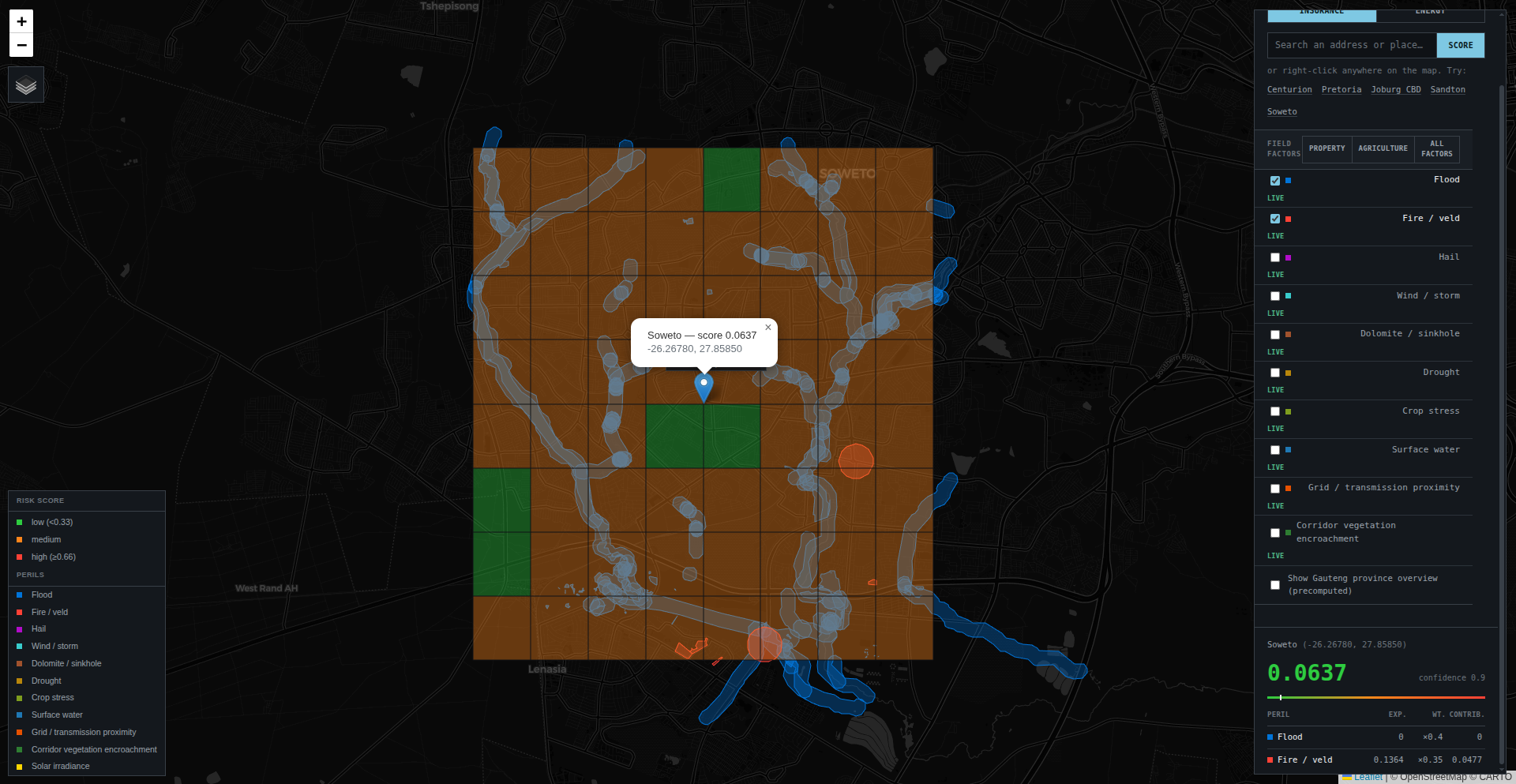
Low-risk reading across central Soweto's 8×8 area grid — watercourse buffers and vegetation zones scored live, confidence 0.9.
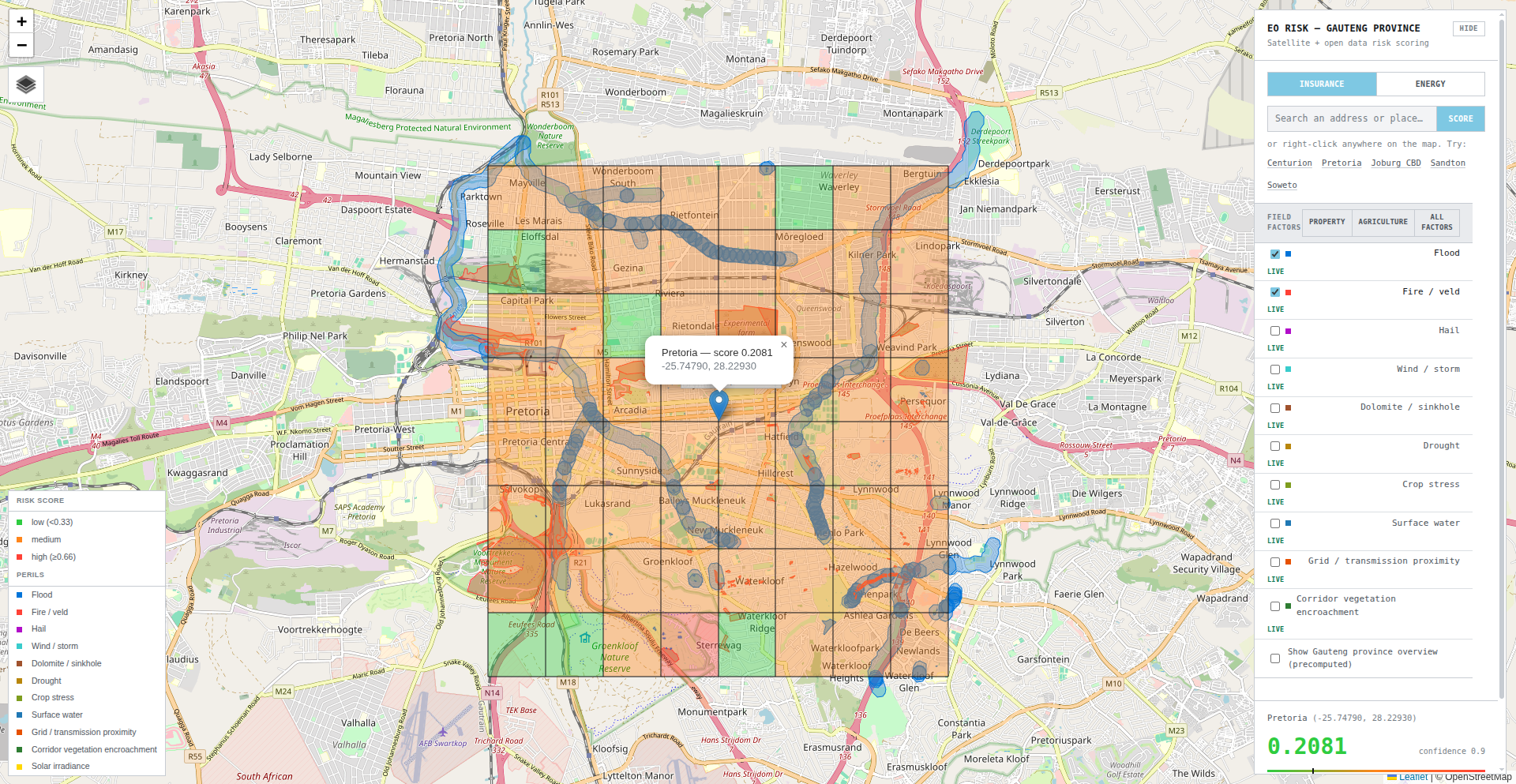
The area console: live address search, an Insurance/Energy vertical toggle, and a scored grid over central Pretoria on OpenStreetMap.
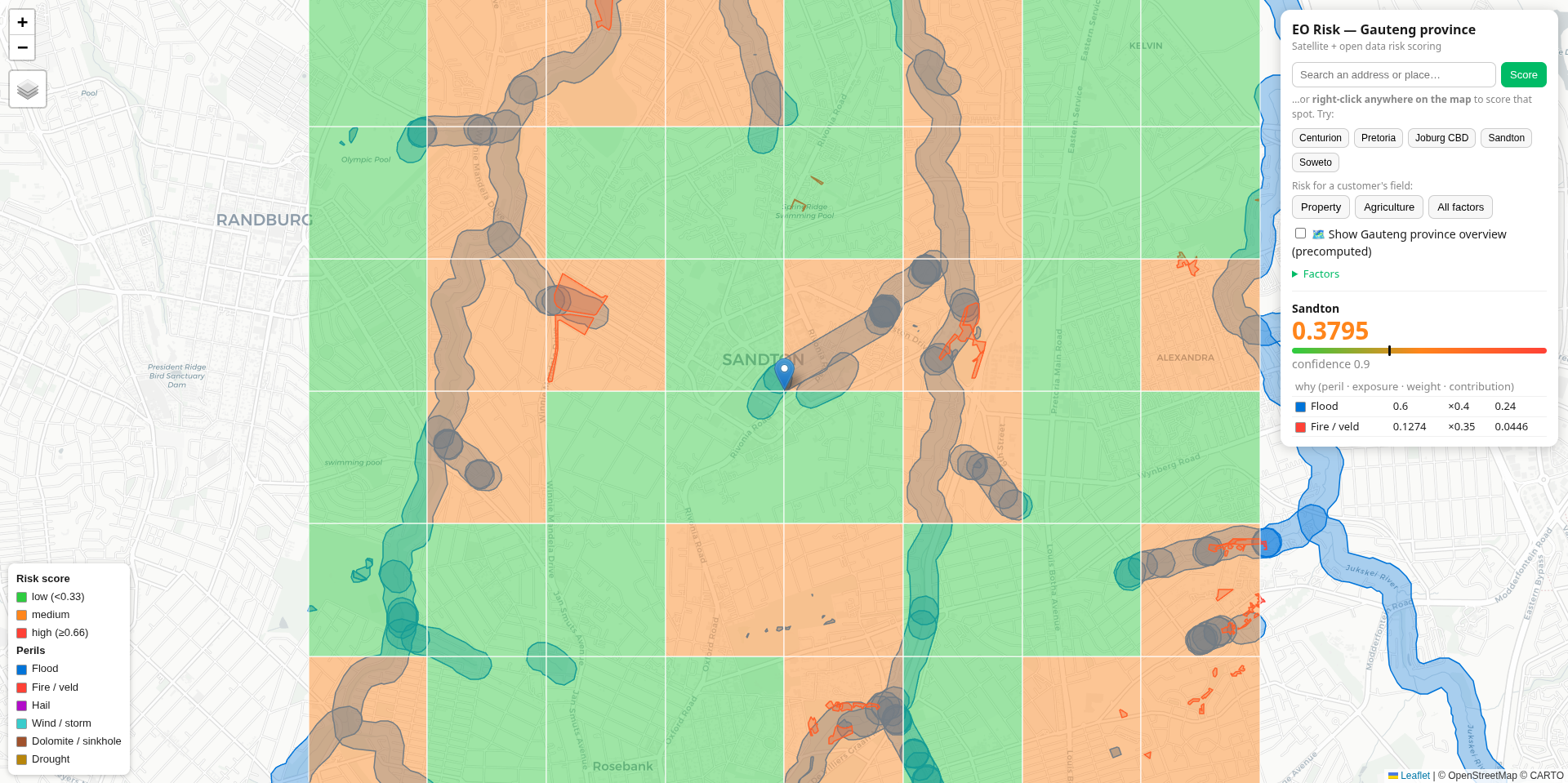
The same engine, a second vertical: solar-siting suitability for Sandton — irradiance, grid proximity, and corridor encroachment scored independently, no new integration required.
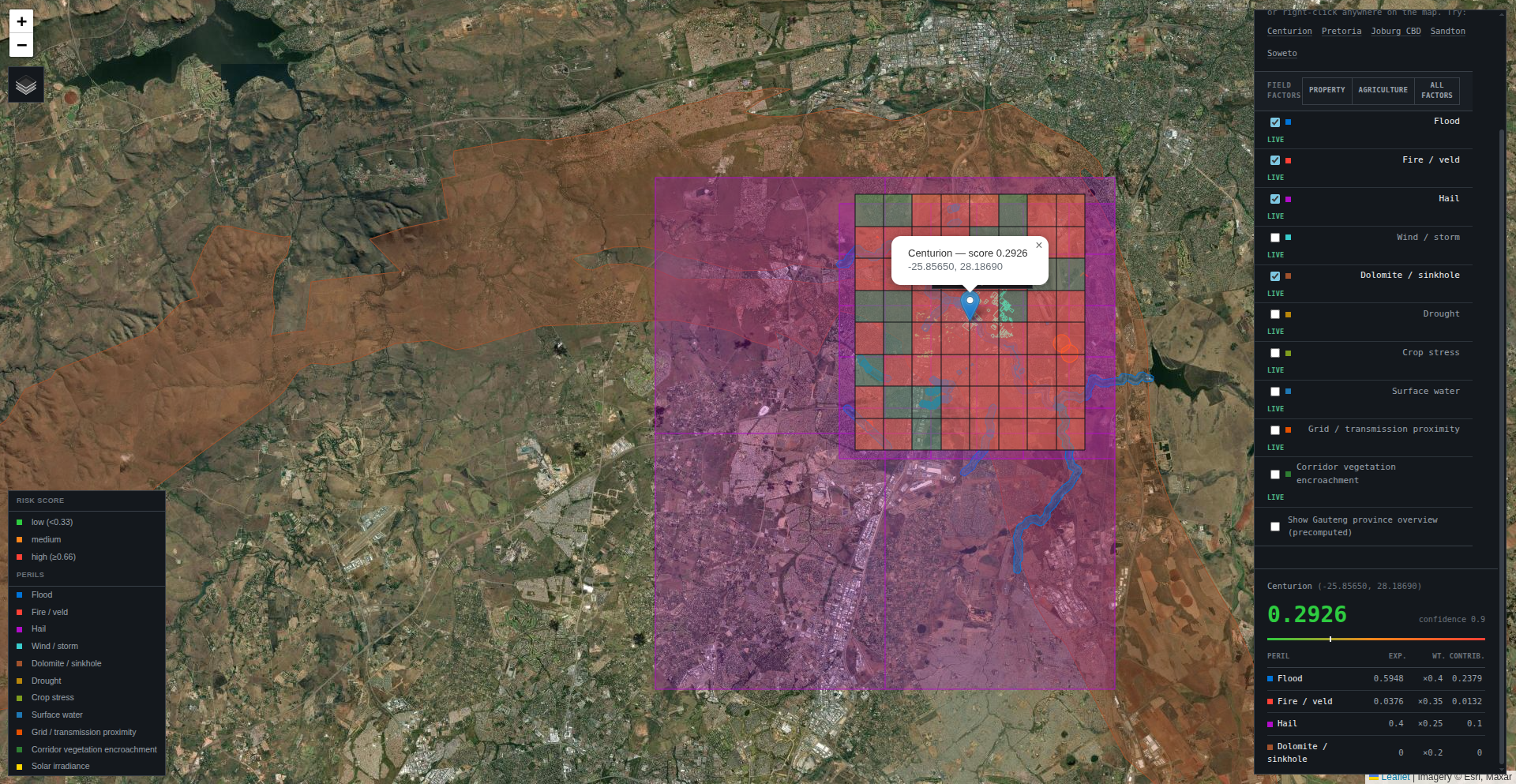
Satellite basemap with GDARD dolomite extent over the sinkhole-prone western corridor. Flood is the leading contributor here, hail close behind — confidence 0.9.
Start with a low-commitment evaluation. Convert to an annual plan once it's embedded in your workflow.
Pay per property scored. No long-term contract required. Ideal for evaluating the platform before integration.
Once integrated into your underwriting or claims workflow, a predictable annual plan. Product D (Water/Drought Risk) is a pure upsell on the same integration.
The same imagery, PostGIS core, and API contract — each vertical brings its own factor-set and formula behind a stable interface. Product D and Energy are already built on the shared core; activating either for a customer requires no new integration.
Roof, footprint, vegetation, and hazard exposure → a property risk score. The primary product, actively building toward pilot readiness over one South African metro.
POST /assess — address or coordinatesThe same scoring engine turned toward soil moisture, drought stress, and water-body levels — built and scoreable today, dormant by default until a customer activates it. Sold to the same insurers and reinsurers as a zero-integration-cost upsell.
A different scoring shape entirely — suitability, not risk. Irradiance, grid access, and terrain scored for solar-siting decisions, sold to private developers and installers, not utilities.
Send an address. Receive a risk decision. No site visit, no geospatial tooling, no guesswork.
Request a Demo →